How to Keep Going When You Don’t Feel Motivated
How to Keep Going When You Don’t Feel Motivated?
Some days, working, exercising, or taking action toward your personal goals feels easy. On other days, even starting the simplest task can feel difficult.
This does not mean you are lazy or undisciplined. Motivation naturally changes depending on factors such as sleep, stress, energy levels, mood, and daily responsibilities.
The problem is not losing motivation. The real problem is waiting until you feel motivated before taking action.
You do not need to feel equally motivated every day to keep moving forward.
Why Does Motivation Change?
When you set a new goal, the initial excitement can make taking action easy. However, that excitement usually fades over time, and relying only on how you feel can make consistency difficult.
Sustainable progress is therefore not about remaining highly motivated all the time. It is about creating a system that continues to work even on days when your motivation is low.
What Does the Research Say?
Research suggests that the reasons behind our actions can influence how consistently we maintain them.
Behaviours driven only by external pressure, guilt, or other people’s expectations can be difficult to sustain. Behaviours connected to your personal values and goals, however, may be easier to maintain over time.
Strong intentions do not always lead to action. Deciding in advance when, where, and how you will begin can help close the gap between intention and behaviour. Repeating the same behaviour under similar conditions can also make it feel more automatic over time.
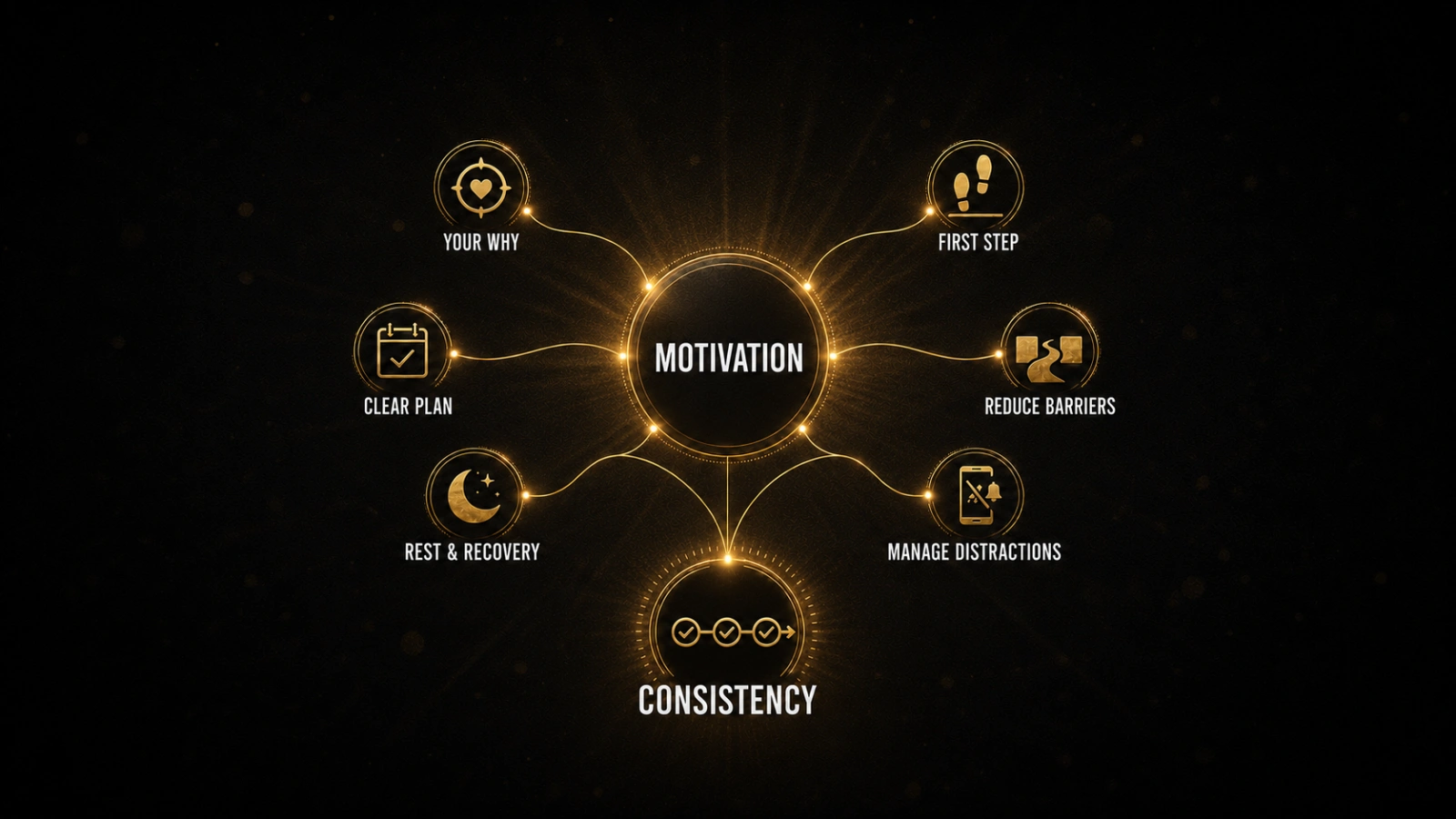
Instead of focusing only on increasing motivation, focus on creating conditions that make taking action easier.
Discipline Does Not Mean Constantly Forcing Yourself
Sustainable discipline is not based solely on willpower. It also means:
- Deciding in advance what you will do
- Reducing the barriers that make starting difficult
- Managing distractions
- Adjusting your plan when necessary
- Returning to your routine after a setback
Constantly pushing yourself harder whenever you struggle can eventually lead to exhaustion. However, abandoning your plan every time motivation drops will also make progress difficult.
The goal is to find a sustainable balance between these two extremes.
Motivation Can Come After You Start
Many people wait to feel motivated before taking action. However, motivation does not always work in that order.
Sometimes, motivation appears only after you take the first step.
Opening your laptop, putting on your workout clothes, reading the first page of a book, or beginning a short walk can reduce the mental resistance to starting.
Instead of telling yourself, “I have to finish everything today,” try saying:
“I will simply start and reassess how I feel after a few minutes.”
Often, the hardest part is not the task itself but the transition from doing nothing to taking action.
What Can You Do When Motivation Is Low?
- Identify the first step: Focus on the next immediate action rather than the entire goal.
- Decide in advance: Clearly plan what you will do, when you will do it, and where it will happen.
- Make starting easier: Prepare the equipment, materials, or environment you will need.
- Reduce distractions: Turn off notifications or leave your phone somewhere else.
- Remember your reason: Keep the reason behind your goal visible.
- Focus on the behaviour: Instead of expecting immediate results, focus on completing today’s planned action.
Low Motivation or a Genuine Need for Rest?
Not every feeling of reluctance is something you need to overcome. Prolonged sleep deprivation, intense stress, illness, or unusual fatigue may indicate that you genuinely need rest.
Ask yourself:
“Is starting simply difficult today, or do I genuinely need time to recover?”
If it is temporary resistance, try taking the first step. If you truly need rest, make a conscious decision to recover and return to your routine at the next suitable opportunity.
BWS Strategy: Don’t Leave the Decision to Motivation
Making decisions when your motivation is already low can lead to mental negotiation and make postponing your plan easier.
Instead, plan the behaviour in advance by defining when, where, and how you will begin.
For example:
- “Instead of “I will be more productive,” say:
“Every morning at 9:00, I will spend 30 minutes working on my most important task.”
- “Instead of “I will read more,” say:
“After dinner, I will put my phone away and read for 15 minutes.”
- “Decide in advance what you will do if your original plan is disrupted”:
“If I cannot do it at the planned time, I will begin during the next available period of my day.”
This approach can be applied to work, education, exercise, and everyday habits. The aim is not to ignore your emotions but to prevent temporary changes in motivation from controlling your decisions.
The BWS approach: Motivation may change, but your plan should remain clear. Decide in advance what you will do, when you will do it, and what your first step will be.
Conclusion
Motivation is valuable, but it is not constant. Depending on it alone is not a sustainable strategy for long-term progress.
Consistency becomes easier when you understand why your goal matters, plan your actions in advance, and remove the barriers that make starting difficult.
Do not wait for motivation to arrive. Take the first step; motivation often follows action.
References
1-Ryan & Deci Self-Determination Theory and the Facilitation of Intrinsic Motivation
2-Gollwitzer Implementation Intentions: Strong Effects of Simple Plans
3-Lally et al. How Are Habits Formed?
4-Gardner et al. Making Health Habitual